Managed infrastructure for everything async.
Hatchet simplifies your stack for running background jobs, distributed workloads, and real-time AI agents with a single, scalable, easy-to-use platform.







Core Principles
Traditional infrastructure breaks with AI workloads. Celery can’t checkpoint long-running tasks. Airflow’s scheduler adds 5-30s latency. Temporal is complex to operate and expensive to scale.
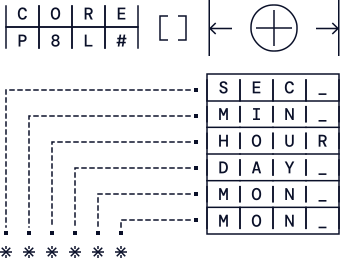
Hatchet is built in Go and backed by PostgreSQL which offers dynamic performance profiles for use cases across your stack so you can consolidate background task infrastructure and simplify operations.
Performance
Start tasks sub 35ms P95. Smart assignment rules handle rate limits, fairness, and priorities without complex configuration.
Durability
Every task invocation is durably logged to PostgreSQL. When jobs fail, resume exactly where you left off — no lost work, no duplicate LLM calls, no engineer headaches.
Code-First
Hatchet SDKs are language native so developers can write business logic as versionable, reusable, testable atomic functions.

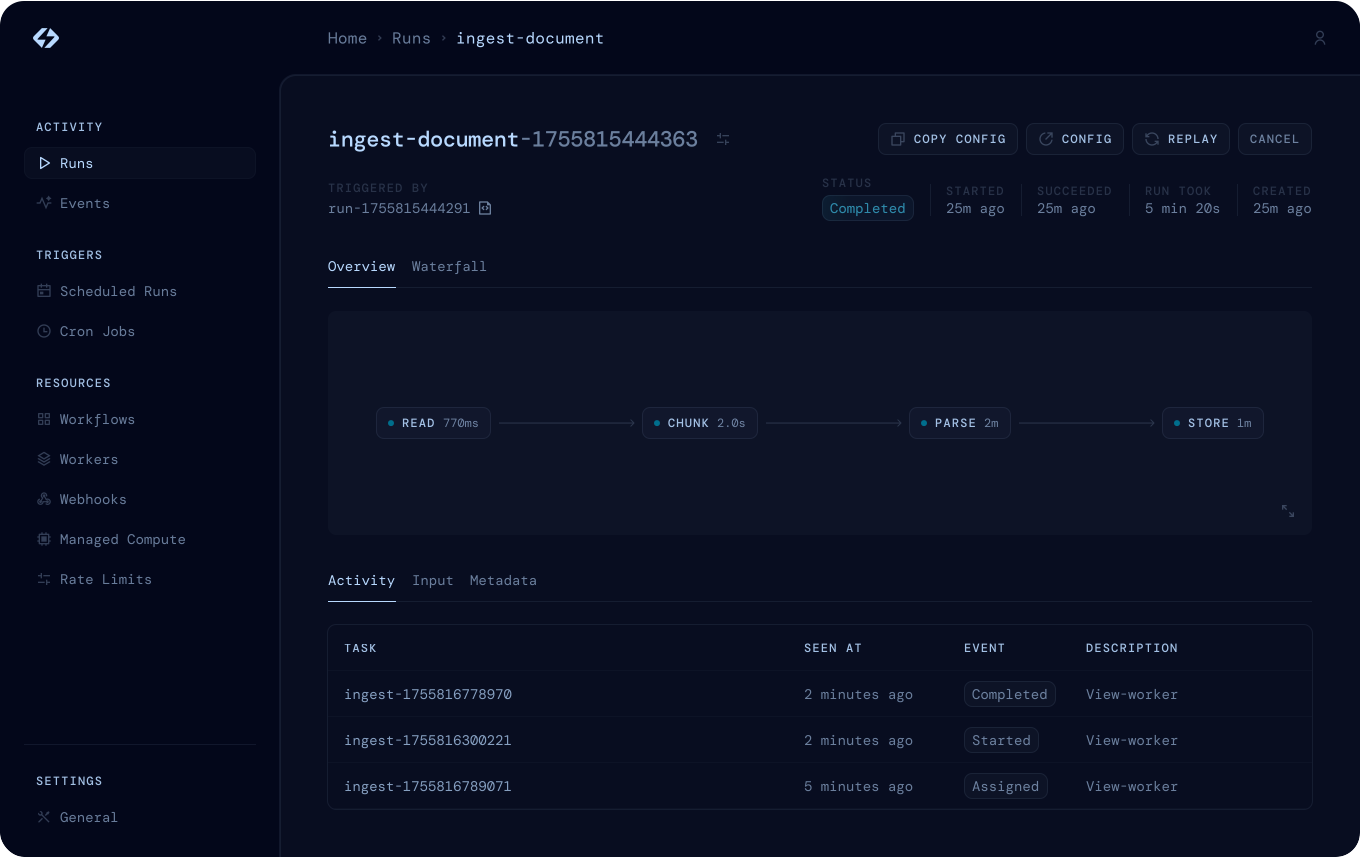
Ingestion & Indexing Pipelines.
Modern data pipelines pull from hundreds of sources with different APIs, rate limits, and failure modes. Traditional ETL tools can’t handle the unpredictability of external services and LLM processing while simultaneously being suitable for real-time requests.
Learn more
Flexibility with Hatchet
Build resilient pipelines that handle real-world complexity. Automatic retries, intelligent rate limiting, and checkpoint recovery mean your data stays fresh without constant firefighting.
Sync from 100+ data sources without building custom retry logic
Transform documents for RAG with guaranteed processing
Update vector databases in real-time with exactly-once semantics
With Hatchet, we’ve scaled our indexing workflows effortlessly, reducing failed runs by 50% and doubling our user base in just two weeks!
 Soohoon ChoiCo-founder · Greptile
AI Requests & Agents
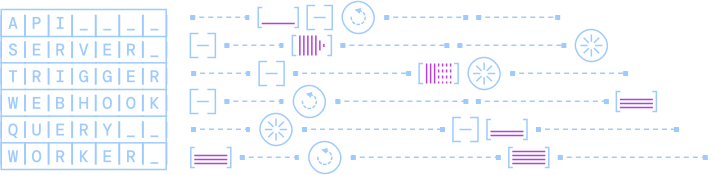
AI agents need complex orchestration — managing tool calls, handling timeouts, maintaining conversation state, and enforcing safety constraints. Most teams end up building fragile in-process systems that are difficult to scale and maintain.

Learn more
Reliability with Hatchet
Define agents as simple distributed functions with built-in orchestration primitives. Set guardrails, manage state, handle failures gracefully. Your agents stay focused on logic, not infrastructure.
Route and prioritize customer queries intelligently
Enable agents to use deterministic tooling already in your codebase
Run long running autonomous research with safety and security constraints
Built-in plumbing for Human-in-the-Loop signaling and Streaming
Implementing Hatchet has revolutionized our task management system, enabling us to handle a growing number of background tasks efficiently.
 Shaun BerrymanStaff SWE · Moonhub
Massive-Parallelization.
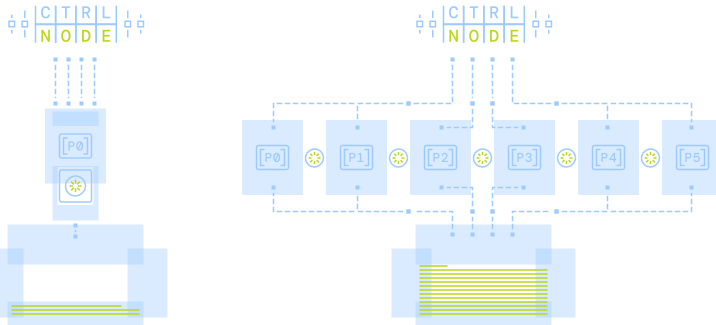
Processing thousands of documents, enriching large datasets, running agent-swarms, or scheduling GPU workloads requires complex coordination. Most solutions either can't scale or become impossibly complex to manage.
Learn more
Scalability with Hatchet
Fan out to thousands of workers with a single function call. Built-in fairness algorithms and resource management ensure efficient utilization without manual tuning.
Process entire document repositories in parallel
Enrich millions of leads without rate limit headaches
Schedule GPU jobs with intelligent batching
Scrape web data with automatic retry and deduplication
Hatchet enables Aevy to process up to 50,000 documents in under an hour through optimized parallel execution, compared to nearly a week with our previous setup.
 Ymir EgilsonCTO · Aevy
AI that scales. Consolidate your legacy orchestration into one Reliable, Scalable, & Secure solution.
Route and prioritize customer queries intelligently
Enable agents to use deterministic tooling already in your codebase
Run long running autonomous research with safety and security constraints

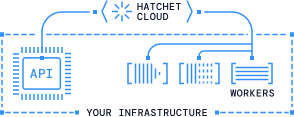
How it works
There are two components to running Hatchet – the orchestration engine and your workers with self-host or fully managed options for both. Since Hatchet is Open Source, you can run multiple deployment strategies (i.e. on prem) without any application changes.
Step 1
Write tasks as code
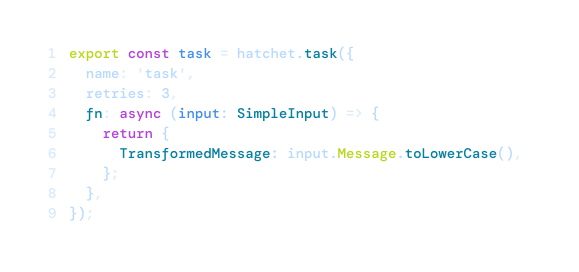
Build workflows by writing simple functions. Your tasks automatically retry on failure and handle complex dependencies between steps.
Step 2
Invoke Tasks
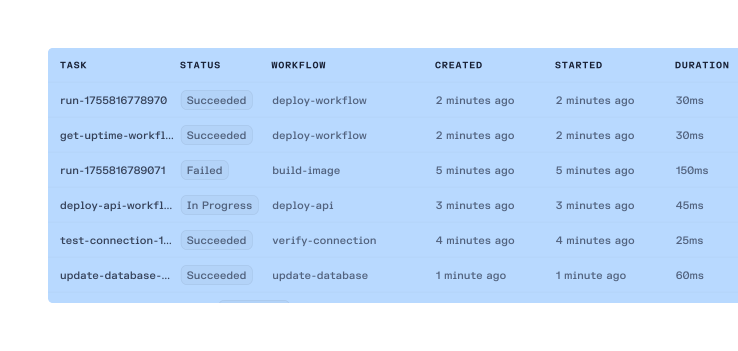
Start workflows from your API, schedule them to run at specific times, or trigger them when events happen. Tasks run immediately or queue up for later.
Step 3
Run Workers in your Cloud

Deploy workers on Kubernetes, Porter, Ryvn, or any container platform. They automatically connect to Hatchet and can scale up or down based on workload..
Step 4
Monitor and Replay
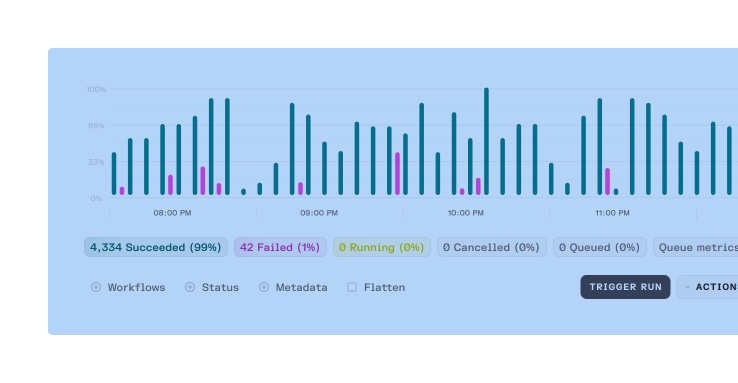
See all your worksflows in the dashboard, get alerts when tasks fail, and export metrics to your monitoring tools. Full visibility (and control) without extra setup.